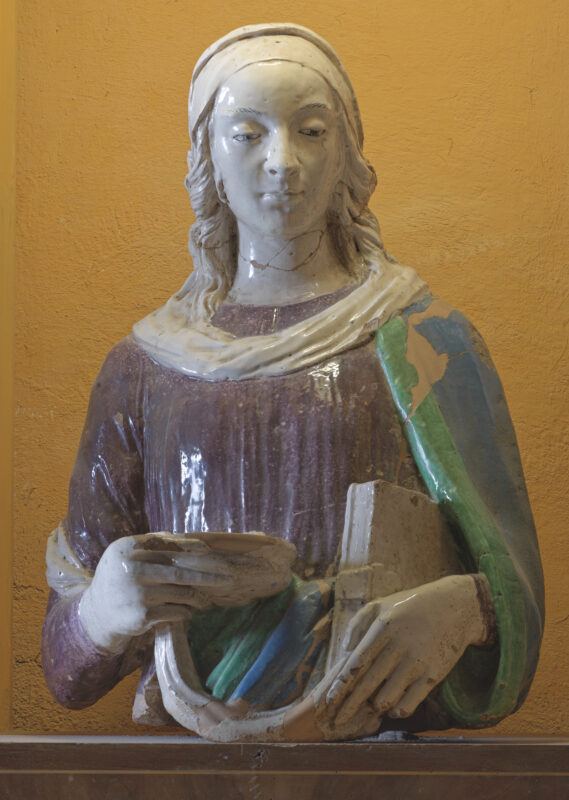
For more than a century, only the upper section of the statue of Saint Lucy, preserved in the Basilica of Santa Cristina in Bolsena, was known to exist.
On 6 November 2026, during the event “Dalla polvere alla luce” (From Dust to Light), the sculpture was finally unveiled in its entirety, following an extensive conservation and restoration project.
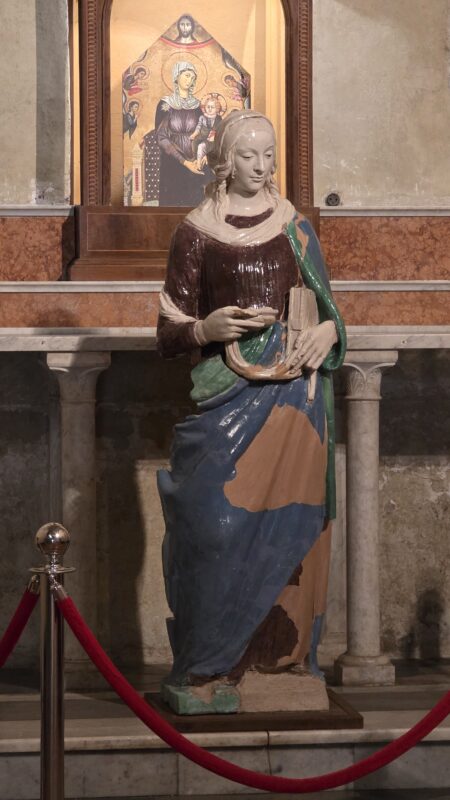
This important achievement has restored a precious example of Renaissance art to the city, bringing to a conclusion a remarkable story of rediscovered fragments, historical research and new discoveries.
Saint Lucy: A Story Left Incomplete for Over a Century
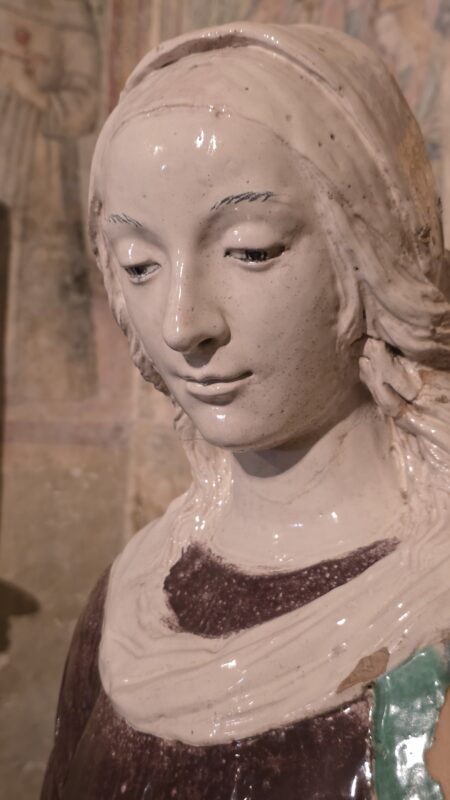
The statue of Saint Lucy is a work in polychrome glazed terracotta, attributed to the Florentine sculptor Benedetto Buglioni (1461–1521) and dated by scholars to approximately 1493–1497.
As early as the late 19th century, the scholar Paolo Zampi described it as a “half statue”. Only the upper part of the figure, representing the saint traditionally invoked as the patron saint of eyesight, had survived in its known form.
.
An unexpected development came around thirty years ago, when the restorer Mariano Marziali accidentally discovered several terracotta fragments that had been embedded in the wall of another chapel within the Basilica for safekeeping.
The fragments were recovered and reassembled, but their original provenance remained unknown for many years.
The turning point came in 2025. Thanks to further research, these pieces were identified as the lower section of the statue of Saint Lucy, finally allowing scholars to reconstruct the history of a work that had been known only in part for generations.
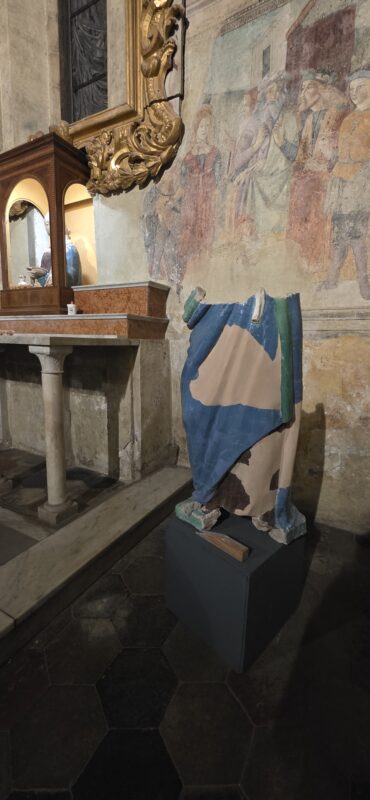
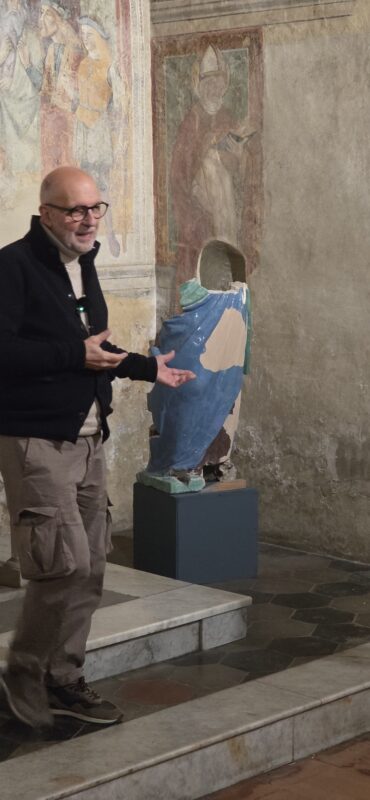
This discovery marked the beginning of the process that led to the restoration and reunification of the sculpture’s sections, culminating in its public unveiling on 6 November 2026.
A Renaissance Work Attributed to Benedetto Buglioni
The rediscovery of Saint Lucy has brought renewed attention to an important chapter in Bolsena’s artistic history.
The sculpture is attributed to Benedetto Buglioni, a Florentine sculptor and ceramic artist active between the late 15th and early 16th centuries, known for his production of glazed terracotta works in an artistic tradition closely associated with the famous Della Robbia workshop.
According to historical research presented by the Italian Superintendency for Archaeology, Fine Arts and Landscape, Buglioni arrived in Bolsena around 1492–1494, as part of artistic projects connected with Cardinal Giovanni de’ Medici, the future Pope Leo X.
.
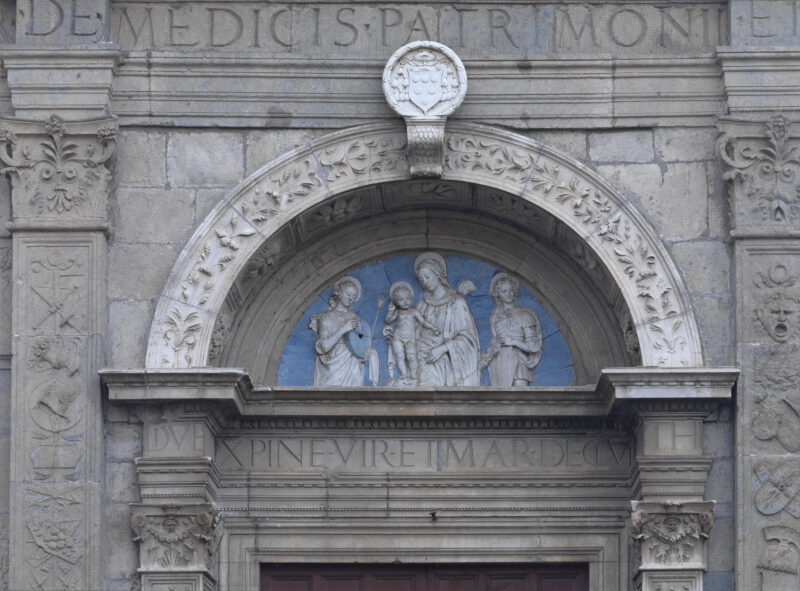
Several important works in the Basilica of Santa Cristina are associated with his activity, including the lunettes above the portals, the decoration of the Chapel of the Blessed Sacrament and other examples of Renaissance art.
The statue of Saint Lucy displays particularly interesting characteristics: an almost life-size figure, sculpted fully in the round, with a posture that, according to scholars, recalls certain models of Florentine sculpture from the same period.
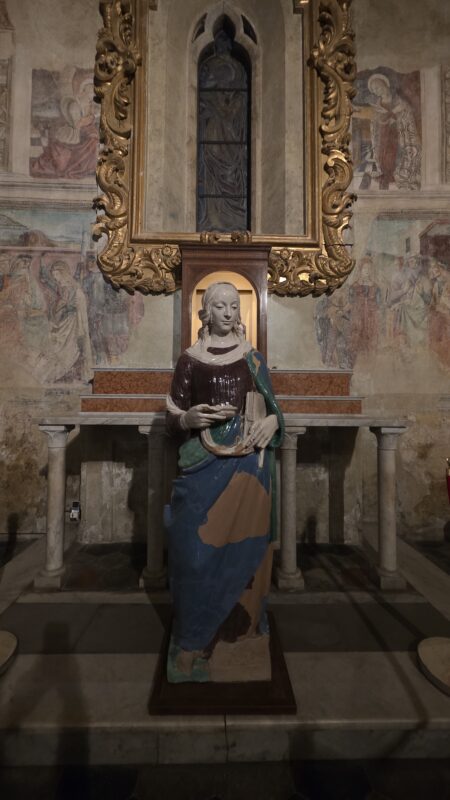
Its original location remains uncertain. The three-dimensional nature of the work has led researchers to suggest that it may once have stood in an elevated position, allowing it to be admired from different angles.
The recovery of its lower section now makes it possible to appreciate the sculpture’s overall composition and gain a deeper understanding of the quality of its craftsmanship.
The Baptismal Font of the Castle District Restored
The restoration project presented on 6 November also involved another significant work from Bolsena’s artistic heritage: the ancient baptismal font of the Church of Santissimo Salvatore, located in the historic Castle district.
Made from glazed terracotta and also attributed to Benedetto Buglioni, the font originally belonged to the medieval Church of Santissimo Salvatore, whose origins date back to the 12th century.
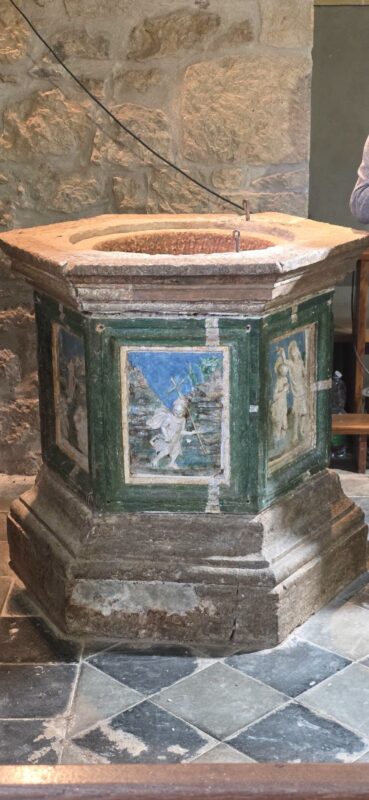
In 1930, the font was dismantled, moved and reassembled inside the new church, situated opposite the Rocca Monaldeschi della Cervara. Alterations made over time had affected both its conservation and the understanding of its original form.
Of particular interest are the six relief panels decorating the basin, depicting episodes from the life of Saint John the Baptist.
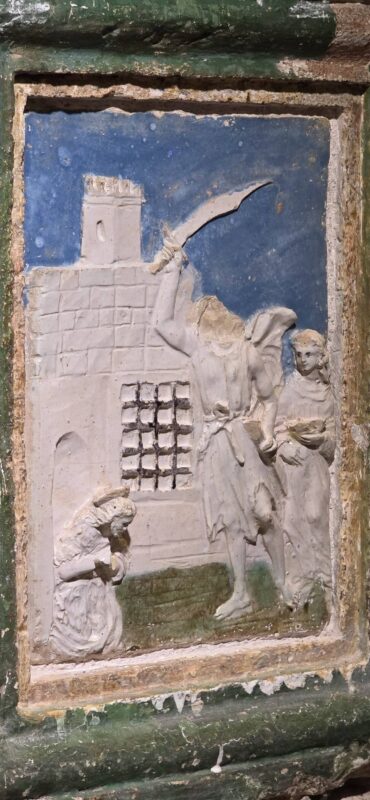
The restoration, entrusted to Louis Dante Pierelli, has brought renewed attention to the refinement of the sculpted details and the delicate quality of the glazes, while also providing new elements for discussion regarding the work’s attribution and methods of execution.
The exact date of its creation and the identity of its patron remain unknown.
From Dust to Light: Rediscovering Bolsena’s Artistic Heritage
The event held on 6 November 2026 at the Basilica of Santa Cristina marked a significant moment in the preservation and promotion of Bolsena’s historical and artistic heritage.
Alongside the unveiling of the complete statue of Saint Lucy and the restoration of the baptismal font, the event also presented the conservation work carried out on the drum of the Church of the Sacred Stones, part of the Basilica’s monumental complex.
These projects were made possible through the collaboration of the Diocese of Orvieto-Todi, the Parish of Saints George and Christina, the restorers and professionals involved, under the supervision of the Italian Superintendency for Archaeology, Fine Arts and Landscape, with support from the Catholic Church’s 8xmille funds and the Fondazione Cassa di Risparmio di Orvieto.
This collective effort has helped preserve works of considerable artistic importance while deepening our knowledge of their history.
The story of Saint Lucy, in particular, demonstrates how a work of art can continue to reveal unexpected discoveries, even centuries after its creation.
In Bolsena, a statue known for generations only in part has finally been reunited in its entirety. And with it, an important piece of the city’s history has been recovered.
Discover Bolsena’s Artistic Heritage
The rediscovery of Saint Lucy offers another reason to explore Bolsena’s rich historical, religious and artistic heritage.
From the Basilica of Santa Cristina, with its early Christian and Renaissance treasures, to the Church of Santissimo Salvatore, in the heart of the medieval Castle district, every visit offers the opportunity to discover another chapter of the city’s history.
A heritage that continues to be studied, preserved and celebrated, and one that deserves to be experienced firsthand.