This article was produced on the basis of Monica Ceccariglia’s lecture, held as part of the “Homo Cogitans” series and dedicated to the figure of Pietro Corcadi and his chronicle of the conflict against Ludwig the Bavarian, and adapted for Visit Bolsena for a general audience.
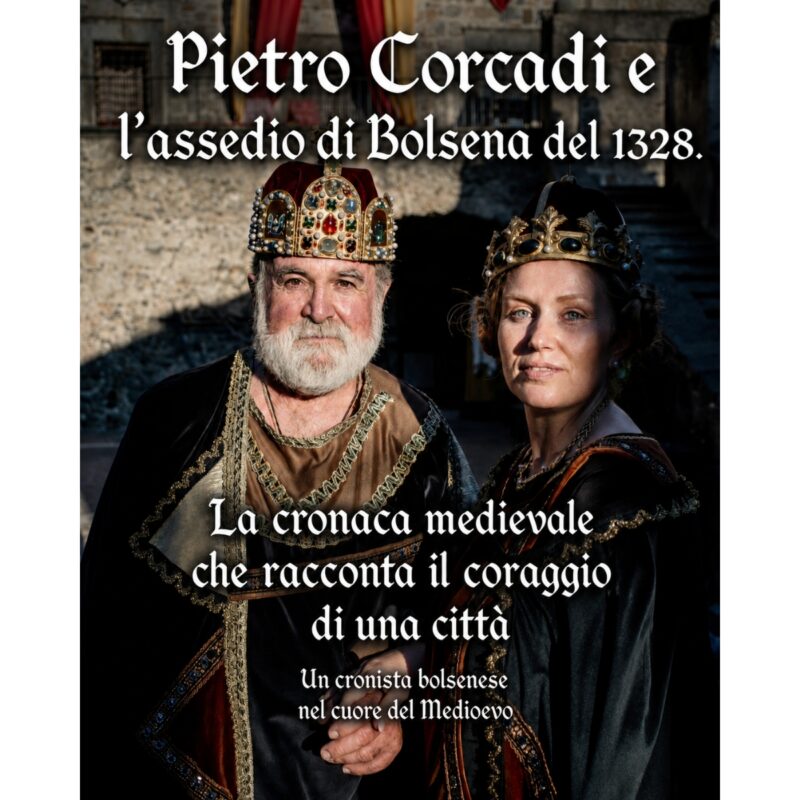
Pietro Corcadi and the Siege of Bolsena in 1328: the medieval chronicle that tells the story of a city’s courage
A chronicler from Bolsena at the heart of the Middle Ages
Among the most fascinating figures in the medieval history of Bolsena is Pietro Corcadi, a notary, podestà, judge and chronicler who lived between the late 13th and the first half of the 14th century. His name is linked to one of the most dramatic and significant episodes in the town’s history: the Siege of Bolsena in 1328, during the conflict against Ludwig the Bavarian.
Thanks to his medieval chronicle, today we can reconstruct not only the political and military events of the time, but also the daily life, fears and courage of the community of Bolsena during one of the most difficult moments in its history.
Who was Pietro Corcadi?
Historical sources on Pietro Corcadi are scarce, but a number of documents and, above all, his chronicle allow us to outline his profile.
Probably born in Bolsena in the second half of the 13th century, he belonged to an influential family with close ties to ecclesiastical circles. In 1281, he took part in the pastoral visit of Bishop Francesco da Bagnoregio at the Basilica of Santa Cristina, together with the town’s leading notables.
In 1294, he held the office of podestà of Bolsena, precisely during one of the most violent attacks launched against the town by the Municipality of Orvieto. During the assault, he was taken prisoner together with his family and brought to Orvieto.
In the following years, he appears several times in official documents as a procurator, ordinary judge and vicar for the Church, evidence of the prestige he had achieved within Bolsena society.
The Chronicle of Pietro Corcadi
The most important work attributed to Pietro Corcadi is a medieval chronicle compiled between 1290 and 1342.
It is a universal history initially written in the vernacular and subsequently translated in part into Latin, drawing on important historical sources of the period.
What makes the work particularly valuable, however, is the attention devoted to Bolsena. Corcadi recounts local events with remarkable precision, describing sieges, battles and protagonists with a wealth of detail that still represents a unique testimony today.
The manuscript that preserved the memory of Bolsena
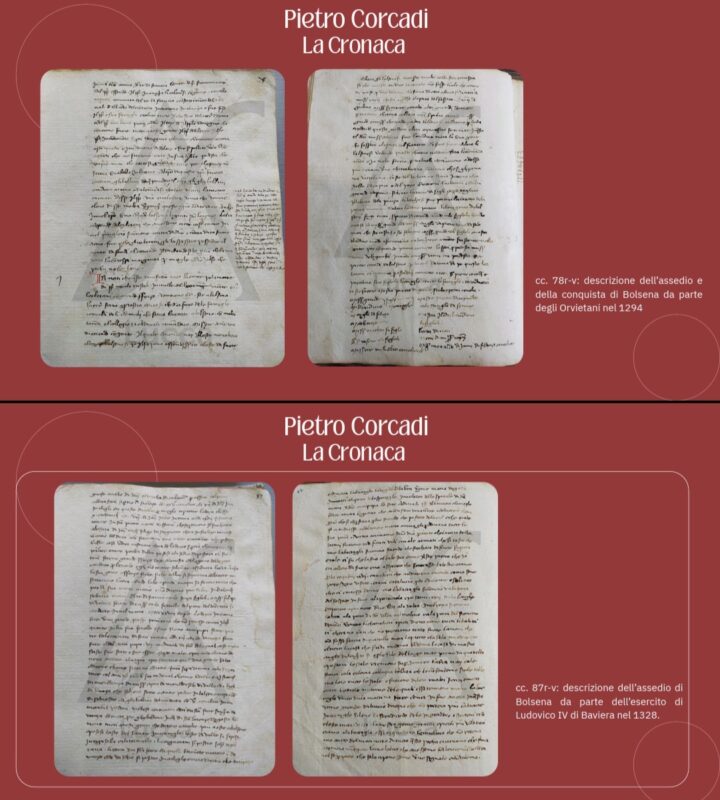
Pietro Corcadi’s Chronicle has come down to us through a precious manuscript codex, which preserves the account of historical events up to the mid-14th century. Among its most significant pages are the description of the siege and conquest of Bolsena by the Orvietans in 1294 and that of the siege of Bolsena by the army of Ludwig IV of Bavaria in 1328, two accounts that remain fundamental sources for reconstructing the town’s medieval history.
The Siege of Bolsena in 1328
In 1328, Emperor Ludwig IV of Bavaria, known as Ludwig the Bavarian, crossed central Italy at the height of his conflict with the papacy.
Aligned with the Church, Bolsena became a strategic target.
According to Pietro Corcadi’s chronicle, the imperial army was formidable: around 5,000 cavalrymen and 10,000 infantrymen, supported by Ghibelline nobles and militias from various territories of central Italy.
The defence of the town, on the other hand, was entrusted to a small number of armed men, the knights of the Rector of the Patrimony of Saint Peter and, above all, the courage of the people of Bolsena.
The courage of an entire community
It is precisely here that the chronicle takes on extraordinary significance.
Corcadi describes a Bolsena in which the entire population took part in the defence of the walls. Men, women, the elderly and children helped repel the attackers using stones, quicklime, pitch and burning bundles of wood.
The clash reached its climax on 14 August 1328, when Antipope Nicholas V urged the imperial troops to launch their final assault.
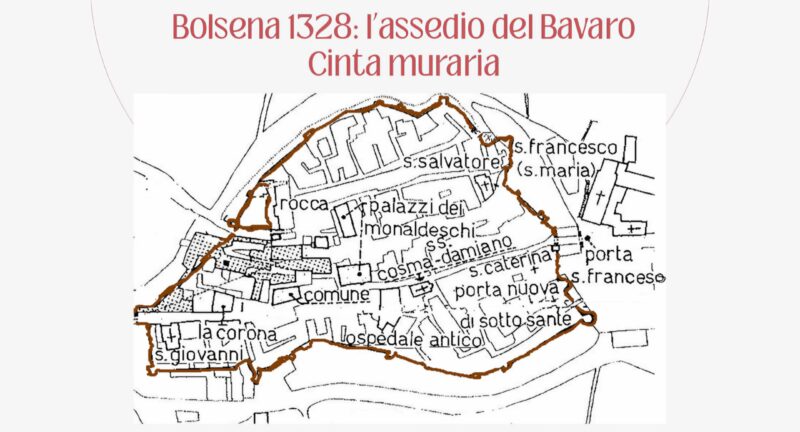
The battle raged between Porta del Fossato, Porta San Giovanni and the area known as Scanceto, but at the decisive moment a violent storm interrupted the fighting, extinguishing the fires and forcing the armies to withdraw.
For the people of Bolsena, it was interpreted as a true sign of Providence.
A historical testimony of inestimable value
The strength of Pietro Corcadi’s chronicle lies in its dual value: as a historical document and as a first-hand testimony.
Through his account, we can learn about medieval Bolsena, its walls, its organisation, its population and the complex political balance of the 14th century.
Even today, his manuscript represents a fundamental source for reconstructing one of the most important chapters in the town’s history.
In the footsteps of Pietro Corcadi
Walking today among the Rocca Monaldeschi, the ancient walls and the medieval gates of Bolsena, it is possible to imagine those days in August 1328, when an entire community defended its town with determination.
Thanks also to the account of Pietro Corcadi, that memory continues to live on, reminding us how Bolsena’s historical heritage remains a fundamental element of its identity today.
History comes back to life in Bolsena
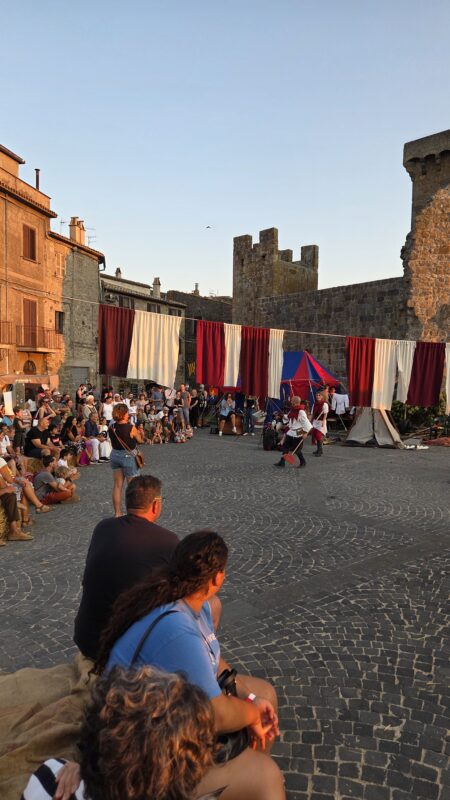
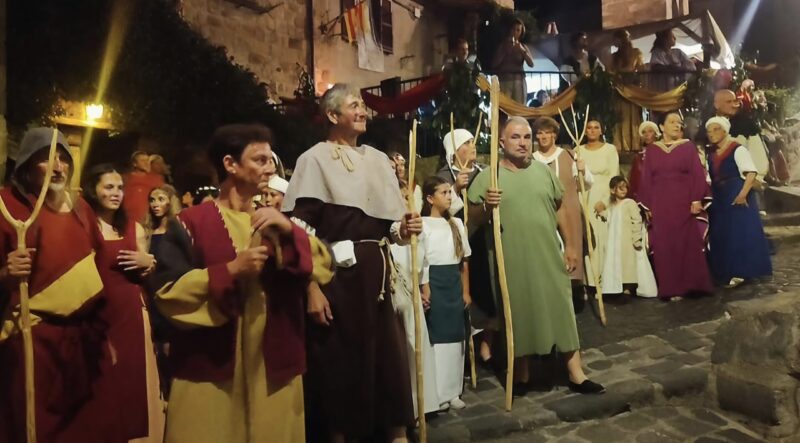
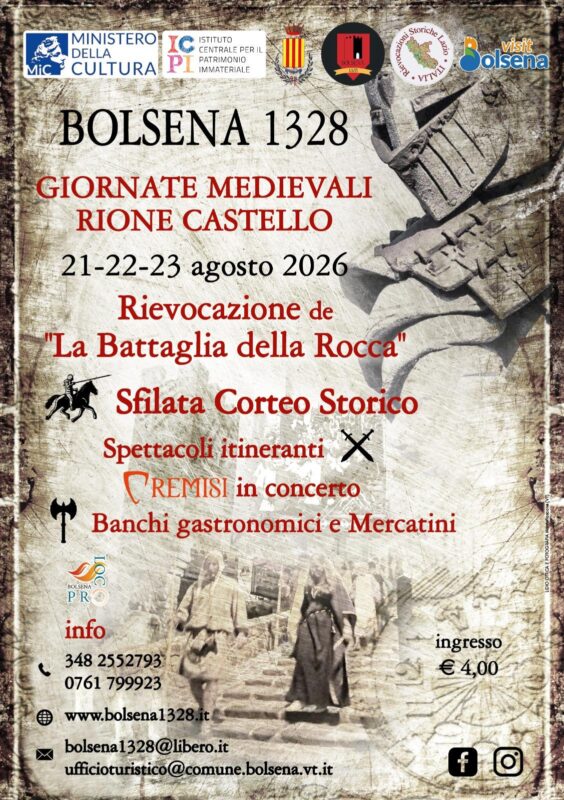
From the pages of the chronicle to the streets of the historic town: the Middle Ages return to life with Bolsena 1328, the historical re-enactment festival that, on 21, 22 and 23 August, will bring the Castello district of Bolsena back to the atmosphere of the 14th century.
Three days to step into history, among processions, encampments, performances and historical re-enactments, in the very places that still preserve the memory of medieval Bolsena.
On 21, 22 and 23 August, history awaits you in the Castello district.
Sources
This article was produced on the basis of the study by Monica Ceccariglia, Pietro Corcadi: profilo di un podestà e cronista del conflitto contro Ludovico il Bavaro (23 May 2026).
The study was developed on the basis of the bibliographical and archival sources cited in the original work, including: C. Dottarelli, Storia di Bolsena con speciale riguardo per la valle del Lago e le isole; L. Miglio, Corcadi Pietro, in the Dizionario Biografico degli Italiani; P. Tamburini (ed.), Un museo e il suo territorio. Il museo territoriale del lago di Bolsena; R. Bruti, Volsiniesi e Bolsenesi illustri tra l’età romana e il XIX secolo; Archivio di Stato di Lucca, Archivi di Famiglie e di Persone, serie Orsucci, O.40.